



I’m going to make an argument that might sound a little crazy, especially considering what we’ve watched over the first 22 games of the season.
I think the Minnesota Wild will eventually need to break up the best line in hockey.
But let me be very clear about something. I’m not saying they should do it right now. In fact, I think they’d be crazy to.
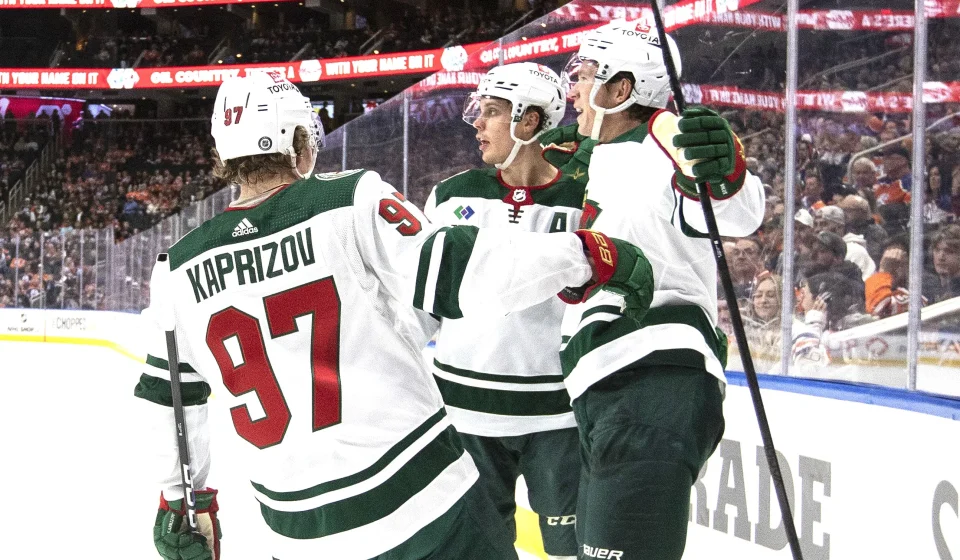
Kirill Kaprizov, Joel Eriksson Ek and Matt Boldy have been absolutely dominant together. Their chemistry is undeniable, they’re producing at an incredible rate, and they’ve given John Hynes absolutely no reason to mess with what’s working.
So don’t. Keep rolling them out there. Let them dominate. Enjoy watching three of the Wild’s best players make life miserable for opposing teams. There’s absolutely no rush to change anything.
But there’s also a difference between building a lineup that wins games in November and building one capable of winning four playoff series in the spring. And that’s where I think the Wild have some work to do.
Just How Good Has This Line Been?
It’s difficult to overstate how dominant the Kaprizov-Eriksson Ek-Boldy combination has been.
Through 22 games, Kaprizov has 17 goals and 37 points. Boldy has added 10 goals and 21 points, while Eriksson Ek has contributed six goals and 17 points.
That’s 75 combined individual points from three players.
But their dominance goes well beyond the traditional box score.
Through the Minnesota Wild’s first 20 games, the trio had outscored opponents 16-0 at five-on-five.
Sixteen goals for. Zero against.
That’s almost unheard of, especially considering the amount of ice time these guys are playing.
Their share of high-danger shot attempts was nearly 65%, meaning they weren’t just capitalizing on their opportunities. They were consistently generating the better scoring chances.
And it wasn’t until Minnesota’s most recent game that opponents finally scored a five-on-five goal against them.
It’s legitimately one of the most impressive stretches of hockey I’ve seen from a Wild forward line. So why on earth would you mess with it? Right now, you shouldn’t. But eventually, I think Minnesota is going to need something more.
Because the Playoffs Are a Different Animal
Here’s where my concern comes in.
The NHL regular season and the Stanley Cup Playoffs are two very different things.
During the regular season, you can get away with riding your best players through stretches when the rest of the lineup isn’t producing.
In the playoffs? Not so much.
You’re playing the same opponent repeatedly. Coaches have days to study your tendencies, identify your weaknesses and develop specific matchups to neutralize your biggest threats.
And if the opposing team figures out how to slow down Kaprizov, Eriksson Ek and Boldy, where does Minnesota turn for offense?
That’s the question that concerns me.
Because while the Wild’s top line has been absolutely incredible, I’m not convinced the rest of the forward group is currently constructed to provide enough secondary scoring over a seven-game playoff series.
That doesn’t mean the other lines are bad. It means I think they’re being asked to do more offensively than they’re realistically built to deliver. And against the best teams in the NHL, that could become a serious problem.
Let’s Look at the Rest of the Lineup
With Minnesota finally getting healthy, the forward lines are starting to look something like this:
Kaprizov – Eriksson Ek – Boldy
Coleman – McCarron – Brink
Trenin – Yurov – Shabanov
M. Foligno – Hartman – N. Foligno
There’s actually quite a bit to like about this group.
Blake Coleman brings experience, versatility and a willingness to play the difficult minutes. Bobby Brink has shown some encouraging playmaking ability while being snakebitten in the ‘goals’ department, and Michael McCarron has provided more offense than I think most of us expected.
Danila Yurov continues to develop well, while Maxim Shabanov has shown he can put the puck in the net.
And that fourth line? I actually like it quite a bit. Marcus Foligno, Ryan Hartman and Nick Foligno give Minnesota a physical, experienced group that should be difficult to play against. Nico Sturm also provides a reliable depth option who can step into the lineup when needed, whether that’s because of injuries or simply giving someone a night off.
But here’s the problem.
Which of those three lines do you trust to consistently generate offense against another team’s top defensive players in a playoff series?
I’m not sure I have a great answer. And that’s concerning.
The Numbers Tell an Interesting Story
Through 22 games, here’s what some of Minnesota’s secondary forwards have produced:
- Maxim Shabanov: 8 goals, 13 points
- Blake Coleman: 6 goals, 12 points
- Danila Yurov: 9 goals, 11 points
- Bobby Brink: 2 goals, 11 points
- Michael McCarron: 4 goals, 9 points
- Ryan Hartman: 3 goals, 7 points
- Yakov Trenin: 0 goals, 3 points
There are certainly some encouraging numbers here.
Yurov’s nine goals are a positive development. Shabanov has demonstrated legitimate scoring ability, particularly on the power play, and Brink has been a solid, hard-working playmaker.
And to be fair, some of these combinations have actually performed quite well at five-on-five.
Coleman, McCarron and Brink have been particularly effective at controlling scoring chances, while the Yurov line has had its moments as well.
So this isn’t me suggesting the Wild’s middle six has been terrible. Far from it. But look at the overall picture.
Outside of Kaprizov, Boldy and Eriksson Ek, Minnesota doesn’t have another forward averaging even 0.6 points per game.
And while points aren’t everything, especially for players being asked to fill defensive or physical roles, they do help illustrate the concern.
Minnesota has several useful forwards. What it doesn’t have is another established offensive difference-maker. That’s a pretty significant distinction.
There’s No Reason to Break Them Up Right Now
I want to emphasize this because I don’t want my argument to get misunderstood.
The Minnesota Wild should absolutely keep Kaprizov, Eriksson Ek and Boldy together for the foreseeable future.
Why wouldn’t they? They’re arguably the most effective line in hockey, the Wild are winning games, and there isn’t another combination on this roster that I’d feel nearly as confident rolling out against an opponent’s best players.
Breaking them up tomorrow just for the sake of spreading out the scoring would make very little sense. And honestly, I don’t think the Wild currently have the personnel to do it effectively anyway.
That’s the bigger issue. Before Hynes can realistically consider separating these three, Bill Guerin needs to give him another legitimate offensive weapon to work with.
Someone who can help anchor a second scoring line and make Minnesota less dependent on its three best forwards playing together. Until that happens, keep doing what’s working.
But the Wild should also be using the next several months to figure out what their playoff lineup needs to look like.
Because the lineup that’s dominating in November doesn’t necessarily have to be the same one they’re rolling out in April. And I’d argue it probably shouldn’t be.
The Wild Need Another Legitimate Top-Six Forward
I’ve been pretty consistent about this, whether in my blogs or our Just Win MN podcast. I think the Wild still need to make a significant addition up front.
Ideally, that player is a No. 1 center. Someone who can create offense, drive a line and take some of the pressure off Minnesota’s existing stars.
But even if that perfect center isn’t available, I think the Wild need to explore adding another established top-six scoring forward.
Not another bottom-six grinder. Not another depth piece who can chip in 10 or 15 goals. A legitimate offensive threat. Someone opposing teams actually have to game-plan around. Because adding that type of player changes everything about how Minnesota can construct its lineup.
And perhaps more importantly, it gives Hynes something he doesn’t have an abundance of right now. Options.
Imagine the Possibilities
Let’s say Guerin finds a way to acquire a legitimate top-six center. Suddenly, Hynes has some interesting decisions to make.
You could put Kaprizov alongside the new center and a complementary winger. You could build another scoring line around Eriksson Ek and Boldy. Or you could experiment with different combinations depending on the opponent.
The important thing isn’t necessarily which two players end up playing together. It’s that Minnesota would have enough offensive talent to spread its best players throughout the lineup without sacrificing its ability to score. And that’s where I think the Wild could become really dangerous. Imagine an opposing coach having to decide which line gets his best defensive matchup.
Do you focus on Kaprizov? Or do you worry about Boldy and Eriksson Ek on another line?
Right now, opponents know exactly where Minnesota’s biggest offensive threat is coming from. And even though they haven’t been able to stop it, the playoffs have a funny way of exposing teams that become too dependent on one source of offense.
The Wild shouldn’t have to choose between having one elite scoring line and having a balanced offense. A legitimate Stanley Cup contender should be able to accomplish both.
And What About Yurov?
I know this is going to come up, especially considering how much I’ve talked about Danila Yurov recently.
He’s off to a good start. Nine goals through 22 games is nothing to dismiss, particularly for a 22-year-old who is still finding his footing in the NHL, at least offensively. And I’m encouraged by what I’ve seen.
But I also don’t think Minnesota can simply assume Yurov is going to develop into the second-line offensive centerpiece this team needs by April.
Could he? Sure. But there’s a big difference between hoping a young player takes another step and acquiring someone who has already demonstrated the ability to produce at a high level.
Yurov might eventually become that player. The Wild just can’t afford to build their entire championship strategy around that possibility.
And that’s not a knock on Yurov. It’s simply acknowledging where this team is in its competitive window.
You Don’t Have to Break Them Up Permanently
This is another important part of the conversation. Breaking up Kaprizov, Eriksson Ek and Boldy doesn’t mean they can never play together again.
Far from it. One of the biggest advantages of having three players with that kind of chemistry is knowing you can reunite them whenever the situation calls for it.
Need a goal late in the third period? Put them together. Have an offensive-zone faceoff against a favorable matchup? Put them together. Need to generate momentum after a couple of difficult shifts? You know exactly where to turn.
That’s a luxury.
But I think it’s a much more valuable luxury when your entire offensive identity doesn’t depend on keeping those three players together every night.
And there’s another advantage to having the flexibility to separate them. If an opposing team finds a way to neutralize that line during a playoff series, Hynes can make an adjustment without completely sacrificing Minnesota’s offensive firepower.
That’s what the best playoff teams can do. They adjust. They create matchup problems. They find different ways to win. And that’s what Minnesota will need more of.
Last game in Boston was a good sign. 6 goals for and not a single one from the top line.
The Wild Have a Real Opportunity Here
Here’s what makes this conversation so interesting. The Wild aren’t some rebuilding team trying to figure out which prospects might become good NHL players three years from now.
They have Kirill Kaprizov. They have Matt Boldy. They have Joel Eriksson Ek. They have Quinn Hughes. They have Brock Faber. They have Jesper Wallstedt. They have a legitimate championship-caliber core.
And when you have that kind of talent, your focus needs to shift from simply developing a competitive roster to figuring out how to win the Stanley Cup.
That might require an uncomfortable decision. It might mean trading a young player you really like. It might mean sacrificing some future flexibility. And yes, it might eventually mean breaking up the best line in hockey. But that’s the reality of trying to win a championship.
And again, none of that means the Wild need to make a change tomorrow. They have time, thanks to their great start to the season. The trade deadline is still months away, and there’s no reason to rush into a move simply for the sake of making one.
But Guerin should absolutely be exploring ways to improve this forward group. And there’s no doubt in my mind that he is.
Because when the playoffs arrive, I’d much rather see Minnesota with too many offensive options than not enough.
Enjoy the Dominance. But Keep Building.
There’s something pretty special happening in Minnesota right now.
Kaprizov, Eriksson Ek and Boldy are playing some incredible hockey together, and I have absolutely no desire to see John Hynes break them up anytime soon. Let them keep doing their thing.
But I also hope Bill Guerin is looking at the bigger picture.
The Wild have a legitimate Stanley Cup window opening in front of them like never before. They have the superstars, the defensive and goaltending talent, and a roster capable of competing with the best teams in the league.
What I think they’re still missing is another proven offensive difference-maker who can help balance out the forward group. And if Guerin can find that player, suddenly Hynes has options he doesn’t currently have.
He can separate Kaprizov and Boldy without sacrificing nearly as much offense. He can create two legitimate scoring lines. And perhaps most importantly, he can make the Wild a much more difficult team to match up against over a seven-game playoff series.
That’s the end goal.
Not breaking up the top line just because it’s producing too much. Not fixing something that isn’t broken. But recognizing that what makes the Wild successful in November might not be enough to make them Stanley Cup champions in June.
For now, keep 97-14-12 together. Keep winning. And let Bill Guerin figure out how to make the rest of the lineup just as dangerous.
Because the goal isn’t to have the best line in hockey. It’s to have the best team in hockey.


