


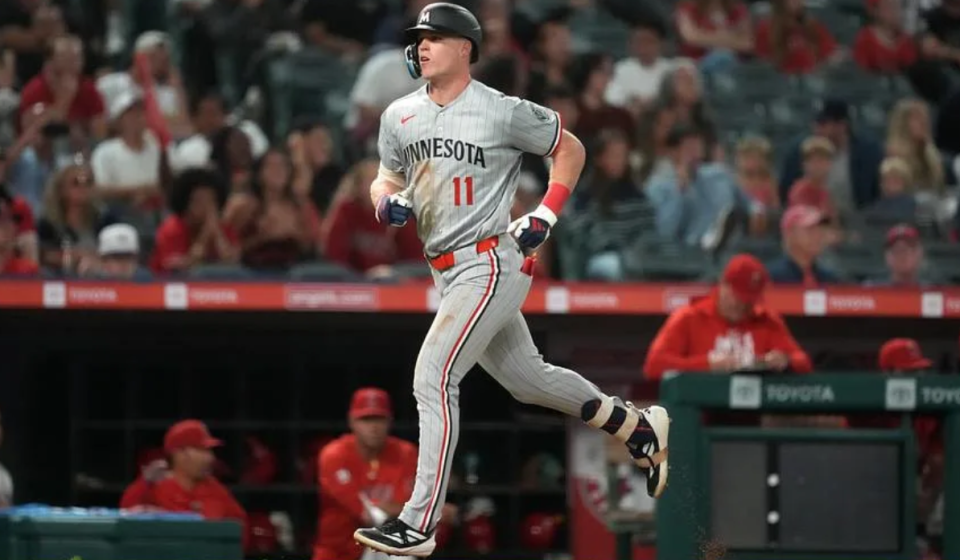

You can’t keep a swing as pure as Walker Jenkins’ in a slump for too long. Here’s the turnaround: 12-for-27, a .444 batting average, three home runs and ONE strikeout over his seven games from September 17–23. The homers will get your attention. The one strikeout is what keeps mine. That combination gives us a much better reason to be optimistic than a couple of balls sneaking over a fence. It suggests we might be watching a hitter get comfortable—not just a prospect occasionally reminding everyone why he was a big deal.
And about those home runs: on September 17, Walker Jenkins hit a game-tying homer off a 100.9-mph Ben Joyce fastball. Not that one swing proves anything permanently, but there’s a pretty big difference between being told a prospect can handle major-league pitching and getting an actual example.
Which brings us to the swing. MLB Pipeline’s scouting report describes a fluid, repeatable left-handed stroke. That’s the appeal of calling Walker Jenkins a pure hitter: the hope that there’s something dependable underneath the results. I don’t need every swing to produce a baseball headed toward the parking lot. Give me a hitter whose game can be built around consistent contact, with power adding to the package. If that’s what Jenkins becomes, we’re going to enjoy watching him for a long time.
The finish to the trip was encouraging for a different reason. Against San Francisco, Walker Jenkins delivered his first professional pinch-hit—a go-ahead single against a first-pitch curveball. No home run required. Just come off the bench and get the hit the team needs.
This is where the 2027 optimism starts making sense. Aaron Gleeman’s coverage has highlighted Walker Jenkins, Emmanuel Rodriguez and Luke Keaschall as part of Minnesota’s changing outfield. That’s a group I want to see develop together. Not because we should pencil them into an October lineup already, but because there’s a difference between hoping one player fixes everything and hoping several young players give the team something to build around. Jenkins could be the face of that group. The Twins still need to put a complete team around it.
Now, before we collectively lose our minds: it’s seven games. Even after this stretch, Walker Jenkins’s overall line sits at .222/.300/.417 in 72 at-bats. We don’t get to dismiss the cold start as a small sample and then treat the hot streak like a guaranteed forecast. That’s not how this works, even when the second version is considerably more enjoyable. My expectation for 2027 isn’t that he hits .444. It’s that he gets the opportunity to keep developing without every bad series becoming a crisis.
Walker Jenkins hasn’t earned the face-of-the-franchise label yet, but he’s giving us a reason to imagine it. We can be realistic about the work ahead and still be excited about having a player who could define the next era of Twins baseball. Those things are allowed to coexist. For now, I want to see his next at-bat—and I’m a lot more interested in what 2027 might look like.



Can’t wait to see the haul we get for him when we inevitably trade him away at the deadline in a few years like we do all our good players